
Healthcare technology for the "Care and Compulsion Act"
What can healthcare technology offer healthcare organisations?
The Care and Compulsion Act explained
A brief explanation of the Care and Compulsion Act
The Care and Coercion Act protects people with an intellectual disability or a psychogeriatric condition such as dementia. The guiding principle here is the right to freedom, based on the ‘No, unless’ approach. This means that the care provider may not impose any measures that restrict freedom unless… The idea is that care is only provided to the client with their consent. And should more be required, a voluntary alternative is sought first. If involuntary care is nevertheless required, the care provider must first follow the Wzd step-by-step plan to determine whether this is possible. Involuntary care is care where the client or their representative does not consent to the proposed care.
How can healthcare technology help?
Let’s first explain what is meant by healthcare technology. In essence, healthcare technology encompasses all technology that can support healthcare. It is also known as ‘care domotics’. Examples include GPS trackers for wandering detection, camera systems, motion sensors, activity monitors and smart mattresses. Healthcare technology can therefore provide support in various ways and contribute to a higher quality of life for the client, thereby ensuring a better life. It also supports the care provider in their daily tasks.
Trends in healthcare technology
It is a fact that interest in healthcare technology is on the rise, but what does this trend look like? Market research firm Berg Insight predicts that there will be a significant increase in the number of people using mobile telecare systems in Europe and North America. The number of users is set to grow from 450,000 to 3.4 million between 2015 and 2021.\\\\nKnowledge organisation Vilans has also written an article on healthcare technology. They have selected 12 technological developments that are already visible today and are likely to be fully established within the healthcare sector in 20 years’ time.
What healthcare aids are available?
There are various types of aids that can support care; here is a small selection:
-
GPS trackers or GPS watches for wandering detection
-
Camera systems
-
Motion sensors
-
Circles of Life
-
Smart mattress
-
Alarm button
-
…
Smart GPS watch gives clients freedom
The guiding principle of the Care and Coercion Act is to grant clients greater freedom; in other words, restrictions on freedom are not imposed unless absolutely necessary. This means that a client may be permitted to go outside alone, provided they remain within a specific area. Allowing a client to go out alone without care technology is not possible due to the risk of them getting lost. A solution to this is to use a Spotter® GPS watch for seniors. A watch that is already widely used in care homes and is popular with clients. In other words: not a stigmatising alarm button, but a ‘modern’ watch.
How does a GPS watch for the healthcare sector work?
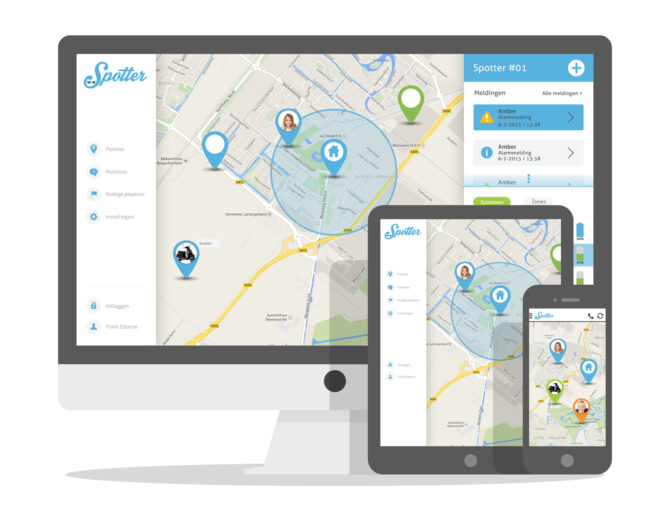
It’s very simple. The Spotter® GPS watch is worn by the client and is connected to the care home or family. Online software and an app allow you to see where the client is, and a telephone connection can be established with the watch if necessary. The GPS watch is also equipped with an SOS button that the client can press in the event of an emergency. It is also possible to set up zones or areas. For example, if the care home is marked as a zone with a radius of 1 kilometre, and the client enters or leaves this area whilst wearing the GPS watch, an alert is sent immediately.This allows the client to go out alone with peace of mind and enjoy greater freedom. And if anything does happen, contact can be made immediately and help provided.
Our experience at Spotter®
Would you like more information for your healthcare organisation?
Are you curious to find out what Spotter can do for your organisation? Please feel free to contact us so that we can provide you with further information. Our products are also available to buy directly from our online shop. We ensure dispatch within one working day so that you can try out the product in practice as soon as possible.


